Tapline radio communications, in H. C. Edgar's words
radio-age-1952-01-tapline · January 1952
Document text
Radio Speeds Work on World's Largest Pipe Line
By H. C. Edgar,
Merchandising Director,
RCA International Division
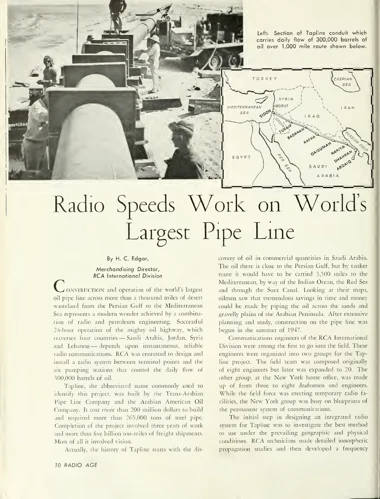
[Opening photograph and map caption, printed page 10: Left: Section of Tapline conduit which carries daily flow of 300,000 barrels of oil over 1,000 mile route shown below.]
Construction and operation of the world's largest oil pipe line across more than a thousand miles of desert wasteland from the Persian Gulf to the Mediterranean Sea represents a modern wonder achieved by a combination of radio and petroleum engineering. Successful 24-hour operation of the mighty oil highway, which traverses four countries — Saudi Arabia, Jordan, Syria and Lebanon — depends upon instantaneous, reliable radio communications. RCA was entrusted to design and install a radio system between terminal points and the six pumping stations that control the daily flow of 300,000 barrels of oil.
Tapline, the abbreviated name commonly used to identify this project, was built by the Trans-Arabian Pipe Line Company and the Arabian American Oil Company. It cost more than 200 million dollars to build and required more than 265,000 tons of steel pipe. Completion of the project involved three years of work and more than five billion ton-miles of freight shipments. Most of all it involved vision.
Actually, the history of Tapline starts with the discovery of oil in commercial quantities in Saudi Arabia. The oil there is close to the Persian Gulf, but by tanker route it would have to be carried 3,500 miles to the Mediterranean, by way of the Indian Ocean, the Red Sea and through the Suez Canal. Looking at their maps, oilmen saw that tremendous savings in time and money could be made by piping the oil across the sands and gravelly plains of the Arabian Peninsula. After extensive planning and study, construction on the pipe line was begun in the summer of 1947.
Communications engineers of the RCA International Division were among the first to go into the field. These engineers were organized into two groups for the Tapline project. The field team was composed originally of eight engineers but later was expanded to 20. The other group, at the New York home office, was made up of from three to eight draftsmen and engineers. While the field force was erecting temporary radio facilities, the New York group was busy on blueprints of the permanent system of communications.
The initial step in designing an integrated radio system for Tapline was to investigate the best method to use under the prevailing geographic and physical conditions. RCA technicians made detailed ionospheric propagation studies and then developed a frequency allocation plan for the many services that would be required. The problems of obtaining radio station licenses and frequency assignments from the four countries were finally solved. Preliminary studies revealed that special antennas would have to be designed in order to reduce static interference from desert sandstorms which had previously obliterated radio reception.
Radio Circuit Completed in Month
Installation of a radio circuit between Tapline's main office in Beirut on the Mediterranean and Ras el Mishaab on the Persian Gulf was the first major task. In one month, this circuit was completed and was carrying executive telephone and teletype traffic. To insure efficient handling of messages over the circuit, two expert operators were furnished by RCA Communications, Inc. When the temporary stations at Beirut and Ras el Mishaab were replaced by permanent stations, the changeover was accomplished without loss of operating time. The direct circuit between these terminals has been in continuous operation, day and night, since service was inaugurated.
As work progressed along the pipe line, RCA engineers provided communications for field construction units, camps, motor caravans, supervisors and survey parties. At all times, field personnel was in constant radio contact with either Ras el Mishaab or Beirut.
As radio engineers and pipe line construction crews advanced from opposite ends of the 1,000-mile course, they encountered one of the world's most barren areas. A tree is a rarity in this land where the average rainfall is only three inches a year. The summer temperature rises to 130 degrees Fahrenheit, with a humidity below seven per cent. In such a climate a man requires two gallons of water a day. Metal surfaces, such as the sections of steel radio antennas, were too hot to touch.
Close teamwork between the RCA International Division at home and abroad eliminated delays in the construction work. In New York, shipments of equipment and supplies were coordinated according to schedules set up by field engineers. There was a constant exchange of information between Arabia and New York on engineering details of the entire system.
Before oil began to flow in the pipe line in November 1950, the communications system installed by RCA had carried more than 500,000 telegrams and more than 750,000 telephone messages.
The completed system, as operated today, has the following specialized functions: (1) dispatching pumping operations, (2) airway and vehicular communications and (3) dispatching movements of oil tankers.
Voice Communications Can Be Coded
Communications for pumping operations consist of parallel telephone and teletype circuits. Signals from the various pumping stations are received by an automatic repeater station at Rafha, midway on the pipe line, and retransmitted from there to other points. Through the use of automatic repeater operation and frequency diversity, nearly 100 per cent reliable telephone service is available between the pumping stations and the terminals at Beirut and Ras el Mishaab. For security purposes, a method was developed whereby all voice communications may be encoded into more than a hundred different combinations.
Since Tapline's pumping stations are separated by as much as 175 miles, air transportation is vital for the speedy shipment of materials, equipment, medical and food supplies, and personnel. Each station has its own airstrip for company airplanes. Communications with both vehicles and airplanes are coordinated with particular airports and stations by the operators at the various radio stations. Calls from an automobile or plane en route across the desert are received on a telephone switchboard like any ordinary call. If desired, communications may be conducted between a vehicle and an aircraft in flight.
[Photograph caption, printed page 11 by sequence: Plodding dromedaries form an old world foreground against a backdrop of Tapline's radio towers.]
[Photograph caption, printed page 12: Radio antennas designed by RCA and erected at one of the oil pumping stations in Saudi Arabia.]
All six airports are equipped with RCA air navigational beacons for the safe guidance of transport planes. Shortly after the beacon system went into operation, some of the commercial airlines changed their routes in order to take advantage of these navigational facilities.
Old and New Worlds in Contrast
Oil from Saudi Arabia reaches the end of its journey through Tapline at Sidon, on the Mediterranean, where tankers are loaded. Radio antennas towering above the orange and fig trees of this ancient city offer an unusual contrast between Old and New Worlds. Actual dispatching of tankers is controlled from the main office at Beirut by means of the radio station at Sidon. This station also supplies vital weather information to the tankers being loaded.
To accomplish the various specialized functions, the RCA-designed communications system utilizes frequencies from 250 to 88,000 kilocycles. Frequencies in the VHF range are employed for the radio link (instead of wire lines) between Sidon and Beirut. This link is engineered to carry eight voice channels, two teletype channels and two control channels for simultaneous communications in each direction.
A majority of the apparatus for the Tapline radio system was standard RCA equipment, specifically intended for this type of service. However, custom-made components were needed in several cases to meet unusual conditions and requirements.
All transmitting and receiving antennas for the project were custom-made to provide interference-free communications. Antenna towers were designed to withstand the combined forces of the violent sandstorms and high winds that sweep the desert.
Saudi Arabs Trained for Radio Work
Aside from the actual installation of the radio system, the RCA International Division performed many technical and non-technical services which are important for successful operations. One contribution was the training of Saudi Arabs for radio operating and service work.
The two main difficulties encountered in this training were language and inexperience. Few Arabs were able to speak even a few words of English and only a handful of Americans were acquainted with Arabic. But gradually words were exchanged and slowly a new language came into being along the pipe line. It wasn't Arabic or English but a workable combination through which both groups could converse without too much difficulty.
Before the construction crews arrived, most of the Arabs had never seen such simple tools as a screwdriver or monkey wrench, yet in time they learned many skilled trades. After being carefully tested and selected for aptitude, Saudi Arab employees were given instruction in telephone, radio and instrument maintenance by RCA field engineers.
To minimize inventory problems, RCA developed a standardization program for spare-part equipment and techniques. The fewest possible types of tubes, equipment and antennas were utilized wherever specialized functions permitted. As a result, a technician familiar with one station can be transferred to another and find himself acquainted with equipment and procedures.
After the radio system was completely installed, many of RCA's engineers remained as permanent Tapline employees. This is not difficult to understand. At each pump-station settlement are air conditioning and refrigeration plants as well as recreation halls and infirmaries. In addition, the stations have comfortable dwellings, dining halls and athletic fields.
By overcoming such obstacles as climate, language barriers and technical problems, petroleum and communications engineers have made a tremendous contribution to the world's oil economy. Tapline is striking proof of America's ability to cope with difficult communications problems abroad and to solve them successfully.
View original PDF
Document details
 View the original documentView source page
Source citation
RCA International Division / Radio Age. “Radio Speeds Work on World's Largest Pipe Line.” January 1952. radio-age-1952-01-tapline.